Sunday, October 27, 2013

OK guys. This week was interesting to say the least. End of the quarter and report cards coming out. Oh boy. I have a 91 in science, not where I want to be, but I am still doing better than I was this time last year. A couple of things to talk about, including labs. So we are learning about the division of cells, photosynthesis, which I gave the formula for last week, and cellular respiration. All very interesting. All very complex. I have a test on Wednesday on this chapter and I really need to study. So first off, we did a flip book on the division of cells. Mine turned out okay, even though it didn't flip very well. On Friday, we observed onion roots and the division of cells. When the root was cut the cells were in different stages of division, which I thought was so cool. We also did a chromatography lab which I thought was king of cool. That is also the lab we are going to talk about.

The Spinach Chromatography Lab:
 Our question: Do green leaves contain other pigments?


Materials: 
  • Isopropyl alcohol(Rubbing alcohol)
  • Scissors 
  • Spinach
  • Chromatography paper(Filter paper)
  • Paperclip
  • Beaker
  • Tape
  • Ruler
  • Pencil
  • Colored Pencils
  • Quarter

  • Procedure: 
    • . Obtain a strip of chromatography paper.  
    •  Use a ruler to measure and draw a light pencil line 2-cm above the bottom of the paper strip. 
    •  Here is the tricky part! Place the edge of the spinach leaf over the pencil line and using the edge of a coin gently press on the spinach leaf to create a single green line over the pencil line. You want this line to be thin and concentrated with the pigment from the spinach leaf. Therefore, repeat this edging process carefully about 3-4 times. Be sure not to press too hard or you will poke a hole through the paper.  
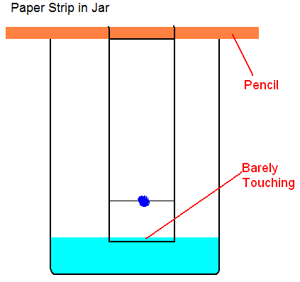
    •  Tape the top of the paper strip to a pencil so that the end of the strip with the green line hangs down. The pencil should be able to sit across the top of the beaker with the bottom of the paper strip just touching the bottom of the beaker. Cut off any excess paper from the TOP of the strip if it is too long.  
    •  Remove the pencil/paper strip contraption from the beaker for the moment. Record observations in data table.  
    •  Carefully add isopropyl alcohol to the beaker until it reaches a depth of 1-cm in the beaker.
    • Lay the pencil across the top of the beaker with the paper strip extending into the alcohol. MAKE SURE THAT THE LEVEL OF THE ALCOHOL IS BELOW THE GREEN LINE ON YOUR PAPER STRIP! IF THE ALCOHOL IS GOING TO COVER THE GREEN LINE, POUR OUT SOME ALCOHOL BEFORE YOU GET THE GREEN LINE WET!  
    •  Observe as the alcohol gets absorbed and travels up the paper by capillary action. This may take up to 20 minutes. Do not touch your experiment during this time.  
    •  When the alcohol has absorbed to approximately 1-cm below the pencil, you may remove the pencil/paper strip from the beaker to dry on your counter. With a pencil, mark the distance the alcohol has traveled on the paper, as well as the distance each pigment has traveled.  
    •  Using colored pencils, draw your results in the data table. 
    •  
    •  Using a ruler and the following formula, measure the Rf values of each pigment.  
    • Since the fastest molecules will travel the greatest distance, or to the highest point along the strip, 
    • the relative distances can be measured, and the flow rate (migration) of the molecules (Rf) can be 
    • calculated by using the following formula:  
    •  Rf = Distance pigment traveled 
    •  Distance solvent traveled 

    Sunday, October 20, 2013


    Hey guys and girls. Not much to  talk about this week. We only had one lab. We had a quiz on osmosis compounds elements and macromolecules on thursday, and I got  a 91%, the worst test or quiz grade I have had this year. I really should have studied more. Next time, instead of 15 minutes I will do it for an hour. We have now moved onto photosynthesis and all the stuff related to it. The chemical formula for photosynthesis is 6H2O + 6CO2 -> C6H12O6 + 6O2. So it is 6 water molecules + 6 carbon dioxide molecules and then add light and you get C6H12O6, which is sugar + O2, which is oxygen. The carbon dioxide comes in through a small opening in the leaf called a stomata, which oxygen also comes out of. The carbon dioxide mixes with the water that comes in through the roots and light transforms into food. The light is caught by chlorophyll. Pigment is a substance that adds color to the plant.

    Sunday, October 13, 2013

    Hey everyone. We are learning about different macromolecules just like last week. I really understand this topic, but I do need to study more. And I was out lats week so i need to catch up on my labs. I am not really sure how much I missed in class, but I am sure I will find out tomorrow. We had one lab this week, and it was about eggs. So here is the lab.

    The Egg Osmosis lab:

    Materials needed:

    • 1 egg
    • scale
    • observation sheet should include days 1, 3, 4, and 5 and have the sections mass of the egg and volume of liquid in the beaker
    • white vinegar
    • corn syrup
    • 1 200 milliliter beaker
    Procedure:

    • Weigh your egg on the scale. Make sure it doesn't fall off
    • To the beaker add 200 milliliters of white vinegar 
    • place the egg in the vinegar and put it on a shelf
    • Leave it there for a day
    • On day 3, take down your beaker from your shelf and observe it
    • After you record your findings, take the egg out of the beaker ( if the yoke is no longer in its shell, re-do the first four steps) 
    • Weigh it carefully because it is very fragile 
    • Pour 200 milliliters of corn syrup into the beaker
    • leave it out for a day
    I have no idea what happens next because I wasn't there for the end of the experiment. So i guess record your findings after it has been sitting in the corn syrup.


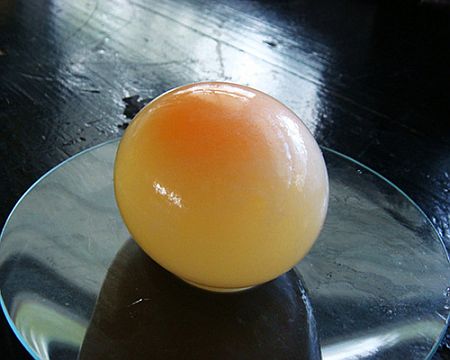
    By the way this is what it should look like on day three


    These are pictures of different types of cells with different amounts of water coming in and out of them. An isotonic cell is healthy. A hypotonic cell has too much water going in and none coming out, so it pops like a balloon. Another unhealthy cell is an hypertonic cell. It has water coming out of it, but none coming in, so it shrivels like a raisin.

    Sunday, October 6, 2013

    Hey everyone. I know last weeks blog was very short and boring. I was tired when I did my post and I am sorry. OK so we did a lab this week, and I took a test on which I got a 95%. The lab was on differrent types of macromolecules and which solutions help to find them. I really enjoed this lab because we got to use chemicals. I really need to work on asking question on tests because I have gotten bad grades on several tests because I didn’t ask questions about things I didn’t understand.

    Here are some definitions.

    Lipids- Lipids are a wide-ranging group of organic compounds found in all living organisms, including humans, plants, and animals. Lipids are the body's reserve supply of energy. Unlike other organic compounds, lipids are soluble in alcohol, ether, and other organic substances but not in water.

    Proteins- Proteins are compounds composed of carbon, hydrogen, oxygen, and nitrogen, which are arranged as strands of amino acids. They play an essential role in the cellular maintenance, growth, and functioning of the human body. Serving as the basic structural molecule of all the tissues in the body, protein makes up nearly 17 percent of the total body weight. To understand protein's role and function in the human body, it is important to understand its basic structure and composition.

    Carbohydrates- Carbohydrates are compounds that consist of carbon, hydrogen, and oxygen, linked together by energy- containing bonds. There are two types of carbohydrates: complex and simple. The complex carbohydrates, such as starch and fiber, are classified as polysaccharides. Simple carbohydrates are known as sugars and they are classified as mono- or disaccharides, depending on the number of sugars present. Monosaccharides consist of only one sugar; disaccharides have two sugar molecules bonded together.

    Glucose-Glucose is a carbohydrate, and is the most important simple sugar in human metabolism. Glucose is called a simple sugar or a monosaccharide because it is one of the smallest units which has the characteristics of this class of carbohydrates. Glucose is also sometimes called dextrose. Corn syrup is primarily glucose. Glucose is one of the primary molecules which serve as energy sources for plants and animals. It is found in the sap of plants, and is found in the human bloodstream where it is referred to as "blood sugar". The normal concentration of glucose in the blood is about 0.1%, but it becomes much higher in persons suffering from diabetes.


    Sunday, September 29, 2013

    Hey everybody. No labs to do at home this week, but lots to talk about. I have  a project due tuesday about the parts of a cell. I am making it out of jell-o. It's going to be fun, and taste very good! This week, we mostly talked about the parts of a microscope, did a microscope lab, and reviewed the parts of a cell. I still need to study quite bit for my test on tuesday or Wednesday, but it think i will do fairly well The microscope lab was kind of boring, but it was teaching us how to use a microscope for the most part. I missed the start of another lab because I was out friday, so I will have to make that up. I really hate missing school because I get so behind.

    Saturday, September 21, 2013


    Lots to talk about, but sadly no labs. I went to Kanuga, or Mountain Trail Outdoor School. So much fun! Up near Hendersonville, N.C in the mountains. The weather was really nice. It was really sunny and cool, and the classes were great. The classes my class took were the climbing tower, high ropes, pond and stream ecology, creatures we love to hate, and outdoor living skills. 
    https://www.dropbox.com/sh/jfg4d8gzxiv6mb2/vcid1lH8fn Here are all the pictures of me and my classmates in our classes in Kanuga. The classes were really interesting and fun. I loved the hiking and the cabins, but the shower heads were a little low. I really need to work on my upper-body strength because I could only get about half way up the climbing wall! I was so disappointed when I could not go any farther. I did get over my fear of heights though, so that is good. I was the first to start a fire in the outdoor living skills class with flint and steel, and I got to touch a opossum in the animals we love to hates class. I really enjoyed the experience! All my friends from public school went, and I thought I would miss the opportunity.

    here is a link to their website http://www.kanuga.org/camps-and-outdoor-education/mountain-trail-outdoor-school/

    Sunday, September 15, 2013

    Hey everyone! Not many labs this week, but we did finish a quiz. I got a ninety-five, but there is still room to improve and work on my class skills. As for this week, we are going to the Mountain Trail Outdoor School up near Hendersonville, N.C. I am so excited because all my friends in public school said it was amazing, as has my sister. The middle school is going as are all but 2 of the teachers. This ought to be soo much fun. Our science unit there will be pond and stream ecology, so that will be fun. I am afraid of heights, so I hope to get over that, and I hope to also forge more of a relationship with the kids at my school and with my teachers. The weather is supposed to be chilly, so I am happy about that! To the labs! We finished our spontaneous generation lab, and it smelled terrible, and it was full of fat maggots. Gross! I had a good time observing them though. I can't give any labs, so I will be giving several links to fun science sites.


    • http://www.reachoutmichigan.org/resources.html
    • http://www.sciencebob.com/experiments/ I really love this site. I used it to get an idea for my 5th grade science fair.
    • http://www.sciencekids.co.nz/experiments.html
    Here is an article for all of you news readers like me

    • http://www.businessweek.com/magazine/content/09_36/b4145036678131.htm
    Here is a link that I find so very interesting because it reminds me of Jurassic Park

    • http://online.wsj.com/article/SB10001424127887323699704578328251335196648.html
    Here are some pictures of things we are studying such as cells, homeostasis and other biological pieces

    This is a prokaryote, a cell that has no nucleus.


     A diagram of what stimuli do to your body.


    A regular cell with a nucleus called a eukaryote which most organisms are sorted under.